Archive for the ‘Lower School’ Category

Thursday, October 16th, 2008

Lower School Students Connect to Autumn

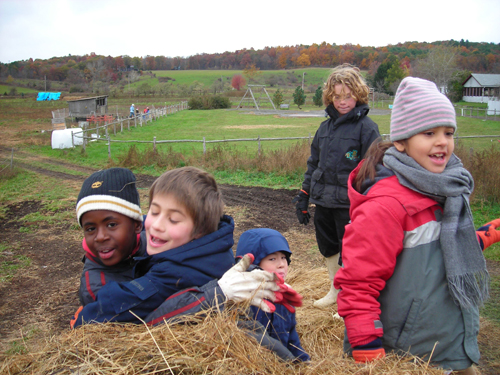
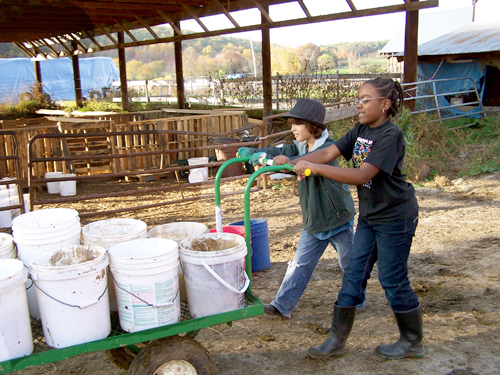
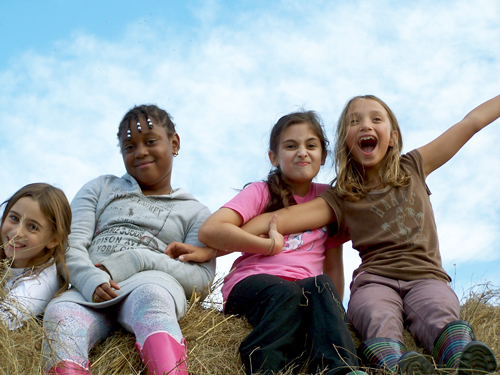
We could not resist including a short excerpt from each of the third and fourth grade farm trips that are away from school this week. It is a thrill and joy to receive these nightly updates from the teachers and hear a snippet of the fantastic sensorial, active experiences that the children are having together.From Kate’s fourth grade farm trip: “We started off early this morning, some of us had to wake up at 5:45 to feed the animals! The rest of us got started around seven, waking to a beautiful, golden country morning. For breakfast, we had oatmeal with all the fixings to give us energy for the day ahead. We started off by cleaning up the farm house learning the basics of keeping our living space tidy. After that, we broke into two groups: One group went on a beautiful hike up a mountain. At the top was a view of the whole valley- breathtaking! The other group worked hard to help in the “Market Garden” which is where the farm grows produce to sell in local markets. After a yummy snack of popcorn and apple cider fresh from the presses yesterday, we divided into work groups, gardening, baking bread in a wood oven, and mucking out the cow barn. We sure were ready for lunch when it came!”

From Dot’s third grade farm trip: “After a restful and restorative sleep, we were up and at ’em taking care of the animals on the farm. The rule being that we need to take care of the animals first because then they can take care of us! For breakfast we stampeded (safely) to the communal tables to share pancakes dressed with maple syrup (tapped on site), sausage, and cantaloupe. … On the nature trail, we marveled at the gold and red leaves that canopied our walk and crunched under our feet. The same leaves we would later find next to the barn that were perfect for piling and diving into! … On the trail, we learned how one could find the North Star and use it to track their direction in the woods. We found unusual plant souvenirs, which you will probably find in your child’s jacket pocket on Friday. One child said about their finding, “Feel this. It feels like a balloon.” John showed us how to make a duck sound when we picked “quacking grass.” The children also trail blazed by leading us through the latter part of the trail. They scouted ahead to look for red ribbons tied around the trunks of birch bark trees and maples. Your children and the ribbons led us to a lean-to for a quick stop to gaze at birds’ nests before we took off down the hill for free time.”

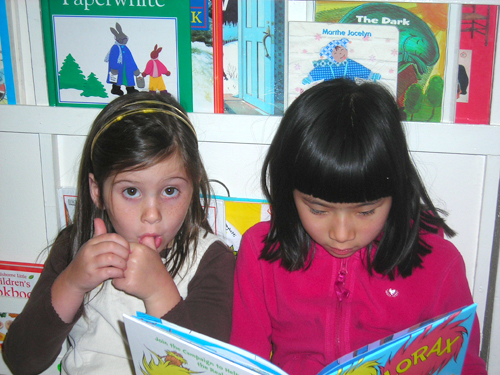
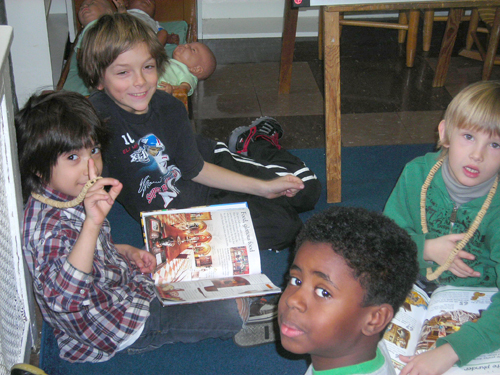
Back at school we are connecting to autumn and the harvest-time bounty in other ways. There are sensorial and active opportunities right here close to home. Four year olds are touching and magnifying gourds, pumpkins, leaves, twigs, pine-cones and corn in the classroom. Below you see them hearing a story called, “Our Apple Tree.” Our kindergartens went to the Green Market yesterday. They chose apples, met farmers, and now will embark on all kinds of apple study and cooking projects. One kindergartener I spoke to said, “We got all different kinds of apples!” Below a group of students makes applesauce.

1016-photo4

1016-photo3

1016-photo2

1016-photo1

Thursday, September 18th, 2008

Fourth Graders Educating for Democracy

By focusing solely on memorizing facts about government and by romanticizing individual behavior of our historical heroes, many schools are missing a crucial opportunity to empower students to act on the issues they care about and to work together to bring about change.

So what’s the effective way to educate for democracy? Students should see a link between motivation and action. Experiencing this link, students naturally want to learn about the facts and the processes which help their cause. The result is knowledge that sticks because it’s acquired by doing and imprinted by caring. Also, organizing as a group for moral support as well as for strength in numbers is a critical, and revolution-making, aspect of activism for kids to discover. Our heroes are incredibly important role models and that is why we learn about them. They also were in many cases connected to movements and organizations. The lesson is that there is power in each of us connecting to people who give us ideas and support for our beliefs.

It makes sense that at LREI we don’t want to miss the opportunity presented by this election year to engage students’ critical thinking. Educating students to be active and engaged in democracy is integral to progressive education. One example comes from fourth grade where students are right now learning how our electoral process works. They are asking (and pursuing): How do we learn more information about the candidates and their positions? How do we have respectful dialogue around passionate topics? Why is this such a historic election? What does that mean to all of us? Essential questions for fourth graders and for all of us.

We looking forward to the fourth graders’ learning and leadership during for the lower school this election year!

Fourth graders made campaign posters to gain understanding of multiple perspectives and to gain insight about how messages are conveyed to the public.

0918-photo-4thgrposter

0918-photo-4thgrposter2

Thursday, June 12th, 2008

First Graders Open Up Shop

Last week one of our first grade classes opened their very own Learning Center with course offerings that included chess and guitar lessons, as well as horse grooming and self-portrait study. When I arrived at the Learning Center I had to stop at the front desk to choose a course. I was then told to go to the cashier to pay a fee after which I was escorted to the section of the room where my course was being offered. Most lessons were full, but luckily there was room in the horse grooming class. I learned all about the different parts of a horse, how to take care of a horse and the different ways you can ride a horse from a very experienced teacher. A video and model horse was used to demonstrate specific saddling and grooming techniques. “How to” books for each course were available at the door on your way out. What a very impressive learning community!All of that learning helped me work up an appetite so next I visited the Funky Earth Café run by another first grade class. The ambiance was colorful, clean and calm. The background music was upbeat and fun. A very gracious hostess greeted me at the door, asked how many were in my party and seated me at a table carefully prepared for a scrumptious meal. The wait staff immediately brought water to the table and gave me just enough time before coming over and asking me if I was ready to order. The menu included items such as a creative fruit salad, hot crepes and love knot cookies, all made by LREI students. Everything sounded delicious! I ordered a fruit salad and love knot cookies and thoroughly enjoyed every last drop. It was amazing to see the fruits of many weeks of the planning and work of first graders. Proceeds from both the Learning Center and the Funky Earth Café will go to charities selected by first grade students.

Thursday, May 22nd, 2008

Literary Projects in the Lower School

This Thursday, May 22nd is LREI’s Spring Book Sale and Literary Celebration. The Auditorium is filled with so many great book offerings it’s hard for many to make a choice about what to buy.Children throughout the lower school have been working feverishly on literary projects that integrate different curricular areas, help express feelings and emotions, and also give children the opportunity to share all that they know with the rest of the school community.

Early childhood neighborhood trips that encouraged students to notice how things change and grow from season to season have sparked a flurry of writing selections that share the beauty of Spring. First grade projects produced a plethora of non-fiction selections. Hope you were lucky enough to purchase a copy of The Funky Earth Café’s cookbook or one of the numerous How To books from LREI’s first Learning Center.

Second graders worked for weeks on their All About books. Each child chose a
topic to research and to write a book about to share with each other and their families. I had no idea second graders knew so much about so many things! Book topics included community boards, airplanes, painting in NYC, and the Intrepid.

Third graders recently finished writing Color poems. They used their imaginations and senses to think about what a color might smell like, taste like, sound like and feel like, as well as what it looks like. Students used the creative ideas they came up with to write poems about colors.

Weeks of hard work went into researching and writing the script for the first fourth grade immigration musical which was an incredible demonstration of hard work, talent, academic skill and community collaboration. Be sure to also check out the wall of poems written by fourth graders and modeled after poems written by Asian immigrants who came to America through Angel Island.

Books help us all to see new places, learn about new things and connect in many different ways with others at home and around the world. Enjoy your next reading adventure!

Thursday, February 14th, 2008

First Grade Model Park

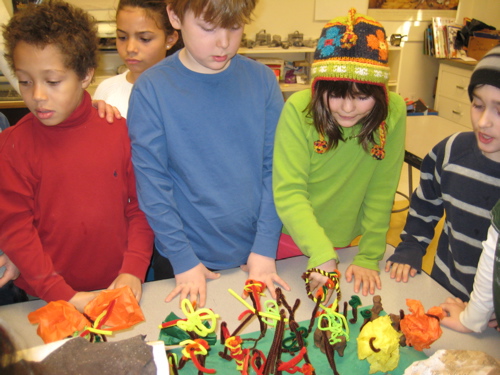
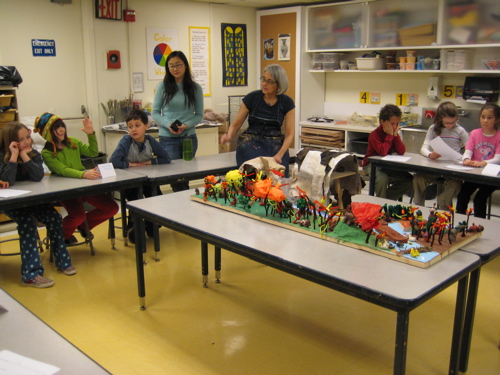
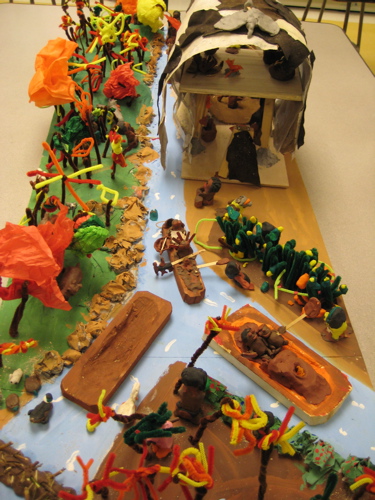
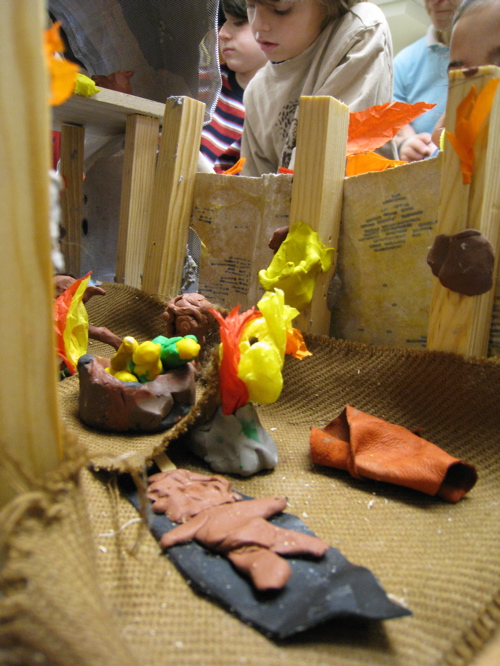
As part of their neighborhood study first graders created their version of a Model Park. Teachers asked children to think about why we need parks. They had many conversations about what things they thought should go into a park. After in class discussions, children interviewed grown ups they knew to learn how people used parks in their neighborhoods. They took field trips to recreational areas around the school community to further observe what individuals they didn’t know use parks for and why. Children took notes during these field trips using a worksheet of specific questions that would generate information needed to design their own area of leisure. Once back in the classroom children used their math skills to organize the data they collected. They created graphs of information to help in their planning and decision-making process. Once children reached consensus on the park’s design, they consulted with the art teacher to determine which materials would be the best to use for a variety of structures. Students drew upon their knowledge of scale to make sure their park features weren’t “too big” so they could “have room for other important stuff, like benches and trees.”

The model park built by children was user friendly and environmentally focused. It included a playground, a bike lane, a skating rink complete with Zamboni, a bathroom complete with toilets, knobs for the sink and signs for the outside. The food bar included a menu, chairs, tables and a hexagon floor. Students also built a farmer’s market that included small fruits and vegetables made from plasticene. They built a tent to keep the food really fresh because it “stays in the shade.” A pond and a grassy field completed this well thought out design.

If you were a fly on the wall during the above creation process this is what you might have heard:

“Community is a group of people who are together.”

“We can do whatever we want with this, and build whatever we want, because this is our park!”

“I don’t think there’s a big difference between animals and nature because animals are a part of nature.”

“It’s ok for us to build a food place anyway. Not all people don’t like to eat in the park! Only the people we talked to, and we didn’t talk to all people!”

This exciting social studies project reflects an integration of social studies, literacy, math, art and community building. Children also learned about the diverse needs of people in inside and outside of their classroom. What an innovative and wonderful snapshot of progressive education in practice.

Thursday, December 6th, 2007

Fourth Grade Immigration Simulation

Reflection from the 2007 Fourth Grade Immigration Simulation: “I felt like I should be more thankful for what we have and be thankful we are in good health. It made me feel like I was rich.”

Ellis Island

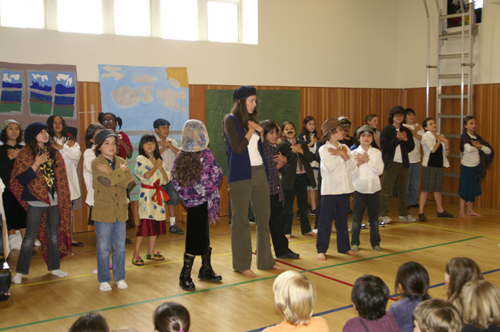
Earlier this week, I walked out of my office because I heard voices that were quite different from what I usually hear in the halls. I had to see what was going on. I saw a long line of children dressed like adults from another era. They wore printed scarves and black wool coats. One fourth grader even wore a black pinstriped suit. Others had leather suitcases, trunks and cloth bags. They wore index cards with unfamiliar names around their necks. They stood on line with solemn faces waiting to be “inspected,” not knowing what their fate would be. Upon entering the inspection room they were asked the same types of questions immigrants were asked in the early part of the last century as they entered Ellis Island. “What is your date of birth? What country are you from? Why do you want to come to America?” Some of fourth graders were detained and had to visit the hospital or take exams to test their mental capacity.

The immigration simulation is part of the immigration unit where students research the different types of people who came to America, the ways in which they contributed to our country’s success and the hardships they had to endure to become a part of their new home and how they took advantage of all it had to offer. In addition to acknowledging those who came to this country through Ellis Island, students also reflect upon those who did not come to this country voluntarily. They do research to find out who else came to this country and how they came? What groups of people were already present?

In an attempt to more fully understand the contributions to the foundation of our city, fourth graders study Africans in Greenwich Village. Who were they? How did they contribute to our neighborhood? Fourth graders also use this information to build a multi-perspective view of history. They learn to more closely examine our nation’s history to make their own determinations about what may have happened that brought us to the place we are today. They also learn to appreciate the hardship, work and tenacity of others. Fourth graders begin to realize the successes we see and experience today were once the dreams of others. They challenge themselves to make dreams for an even better life for those in the future. The Ellis Island simulation is an attempt to provide fourth graders with a hands-on experience that will help them to better understand the human side of textbook history. Fourth graders also took a trip to the real Ellis Island late this week to continue to learn more about the people who came before us.